For decades, quantum computing has been one of science’s most promising yet puzzling frontiers. These futuristic machines have the potential to revolutionize how we process information, model complex systems, and solve problems far beyond the reach of classical computers. Yet one persistent obstacle has stood in their way — the problem of calculation errors. Quantum bits, or qubits, are notoriously unstable, often collapsing or changing state when exposed to even the slightest disturbance. But a recent scientific milestone has changed that narrative. Researchers have now demonstrated that quantum computers can correct their own errors, marking a crucial step toward truly reliable quantum computation.
The Fragile Nature of Quantum Information
At the heart of every quantum computer lies the qubit, a tiny unit of information that can exist as both 0 and 1 at the same time, thanks to a principle called superposition. Unlike classical bits, which hold only one state, qubits allow quantum computers to perform multiple calculations simultaneously. However, this advantage comes with a major vulnerability. Qubits are extremely sensitive to environmental noise — temperature changes, electromagnetic interference, and even cosmic rays can disrupt their fragile quantum states.
When a qubit loses coherence, or falls out of its quantum state, it introduces errors into calculations. Even a single misstep can cause an entire computation to fail. That’s why one of the most important challenges in quantum computing has been developing error correction methods that protect these delicate systems without disrupting their quantum behavior.
The Breakthrough: Self-Correcting Quantum Systems
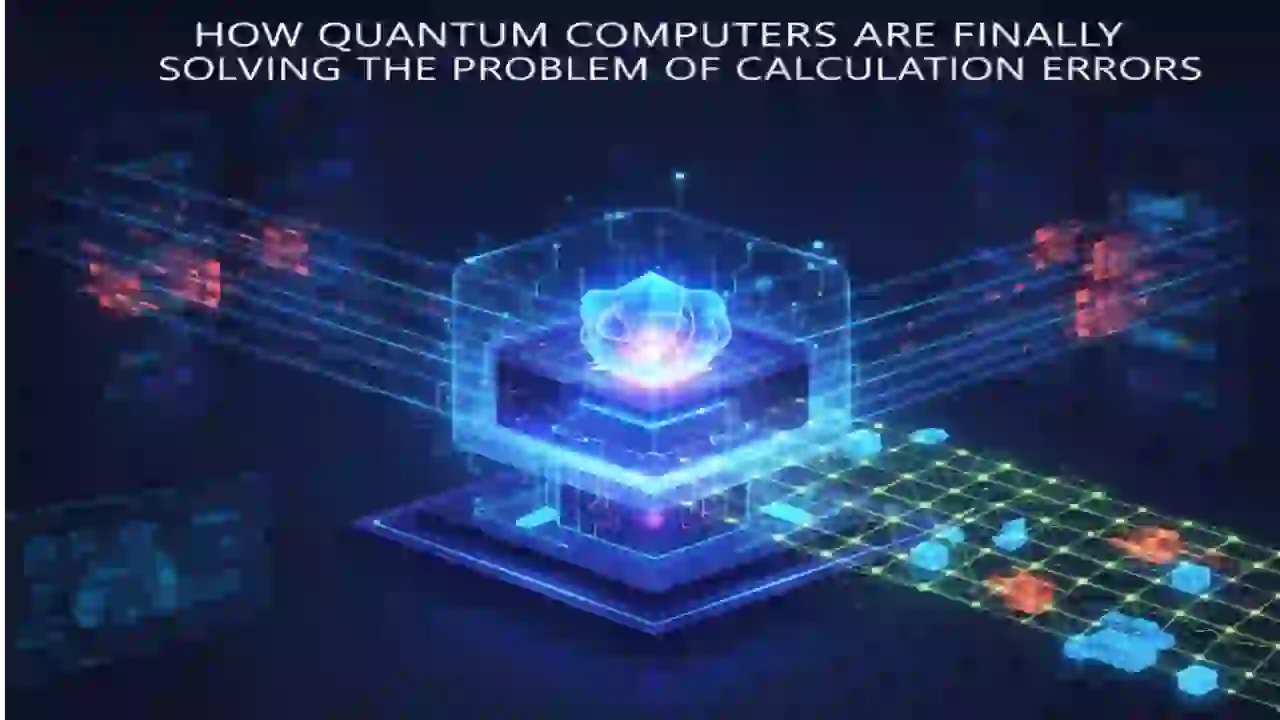
In a landmark experiment, a team of physicists successfully demonstrated a quantum computer that could detect and correct its own errors in real time. Using an array of superconducting qubits, the researchers applied advanced quantum error correction codes — mathematical techniques that distribute quantum information across multiple qubits. If one qubit experiences an error, the system can detect and repair it using redundant information stored in others.
This process works somewhat like how modern data servers store backups or how autocorrect fixes typing mistakes. But unlike classical computers, where copying information is straightforward, quantum information cannot be duplicated directly because of the “no-cloning theorem.” Instead, the system must use entanglement — the mysterious quantum link between particles — to share information in a way that enables detection and correction without measurement.
The result? The quantum processor maintained its computational accuracy for longer periods than ever before, a sign that practical quantum error correction is no longer theoretical but real.
Why This Discovery Matters
Error correction is the key to unlocking the full potential of quantum computing. Without it, quantum systems remain unreliable, limited to small-scale experiments rather than large, meaningful calculations. With it, however, the path opens toward scalable, fault-tolerant quantum computers capable of performing tasks classical machines could never handle — from simulating molecules for drug discovery to optimizing massive logistics networks or advancing artificial intelligence.
This breakthrough also represents a major step toward what researchers call “quantum supremacy” — the point at which quantum computers can outperform the most powerful classical supercomputers. While some experiments have already hinted at this achievement, consistent error correction ensures those results can be trusted, replicated, and expanded.
Building Toward Fault-Tolerant Quantum Computers
To reach the next milestone, scientists must scale up these self-correcting systems while reducing the hardware and computational overhead required. Quantum error correction typically demands many physical qubits to encode a single logical qubit — sometimes dozens or even hundreds. That’s why researchers are now focused on improving qubit stability and developing more efficient error-correcting codes that can operate with fewer resources.
Companies like IBM, Google, and IonQ are all investing heavily in this direction. IBM recently announced progress with its “stabilizer code” systems, while Google’s Quantum AI team demonstrated improved performance using a surface code approach that maintained logical qubits for longer durations. Each success moves the field closer to a new era of computing where errors no longer define the limits of possibility.
Beyond the Lab: Real-World Implications
The implications of reliable quantum computing stretch across industries. In finance, error-corrected quantum systems could enable faster portfolio optimization and risk modeling. In materials science, they could simulate atomic interactions with unprecedented precision, accelerating the discovery of superconductors or new battery technologies. Even in cybersecurity, quantum computers could reshape encryption standards, demanding a shift toward quantum-safe cryptography.
The ability to correct errors also builds trust in quantum results. Until now, skeptics have questioned whether quantum systems could ever be stable enough for practical use. Demonstrating consistent self-correction answers that question and signals that the era of quantum practicality may be closer than most imagined.
The Road Ahead
Quantum error correction is not a single achievement but an evolving field. Each breakthrough refines our understanding of how to stabilize qubits and make their behavior predictable. As new materials, algorithms, and architectures emerge, researchers expect to see exponential improvements in both speed and accuracy.
Still, the road ahead is long. Creating fully fault-tolerant quantum computers — machines that can run indefinitely without human intervention — may take years of engineering innovation. But the recent progress shows that the foundations are already in place.
A Quantum Future Without Errors
The dream of a perfectly stable quantum computer once seemed unreachable, limited by the fragile nature of quantum states. Yet the latest advancements prove that science is steadily solving one of its hardest puzzles. By teaching quantum computers to recognize and repair their own mistakes, researchers have moved a step closer to unlocking the immense computational power hidden within the quantum world.
As these systems continue to evolve, they may redefine what’s possible in technology, science, and beyond — bringing us closer to a future where errors are not barriers, but stepping stones to perfection.